Anthropologists Tend to Ignore Religion and Art in Understanding Other Cultures
Cultural anthropology is a co-operative of anthropology focused on the report of cultural variation amidst humans. Information technology is in contrast to social anthropology, which perceives cultural variation as a subset of a posited anthropological constant. The portmanteau term sociocultural anthropology includes both cultural and social anthropology traditions.[ane]
Anthropologists take pointed out that through culture people tin adjust to their environment in non-genetic ways, and so people living in different environments volition oft accept different cultures. Much of anthropological theory has originated in an appreciation of and interest in the tension betwixt the local (particular cultures) and the global (a universal human nature, or the web of connections between people in distinct places/circumstances).[2]
Cultural anthropology has a rich methodology, including participant ascertainment (often called fieldwork because it requires the anthropologist spending an extended period of time at the research location), interviews, and surveys.[3]
History [edit]
The rise of cultural anthropology took place within the context of the late 19th century, when questions regarding which cultures were "primitive" and which were "civilized" occupied the heed of not only Freud, but many others. Colonialism and its processes increasingly brought European thinkers into straight or indirect contact with "primitive others".[4] The relative status of various humans, some of whom had mod avant-garde technologies that included engines and telegraphs, while others lacked anything but face-to-face advice techniques and still lived a Paleolithic lifestyle, was of interest to the first generation of cultural anthropologists.
Theoretical foundations [edit]
The concept of culture [edit]
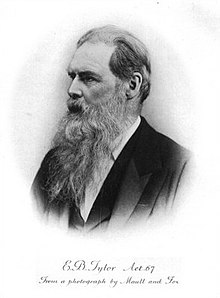
One of the earliest articulations of the anthropological significant of the term "culture" came from Sir Edward Tylor who writes on the offset page of his 1871 book: "Culture, or civilisation, taken in its broad, ethnographic sense, is that circuitous whole which includes cognition, belief, fine art, morals, law, custom, and any other capabilities and habits acquired by man as a member of society."[v] The term "civilization" afterward gave style to definitions given by 5. Gordon Childe, with culture forming an umbrella term and culture becoming a particular kind of culture.[6]
According to Kay Milton, one-time manager of anthropology research at Queens University Belfast, civilization tin be general or specific. This means culture tin exist something applied to all human beings or it can exist specific to a certain grouping of people such equally African American civilization or Irish gaelic American culture. Specific cultures are structured systems which means they are organized very specifically and calculation or taking away any element from that system may disrupt information technology.[7]
The critique of evolutionism [edit]
Anthropology is concerned with the lives of people in different parts of the globe, particularly in relation to the discourse of beliefs and practices. In addressing this question, ethnologists in the 19th century divided into 2 schools of thought. Some, like Grafton Elliot Smith, argued that different groups must have learned from 1 some other somehow, however indirectly; in other words, they argued that cultural traits spread from ane identify to another, or "diffused".

Other ethnologists argued that unlike groups had the capability of creating like beliefs and practices independently. Some of those who advocated "contained invention", like Lewis Henry Morgan, additionally supposed that similarities meant that dissimilar groups had passed through the same stages of cultural evolution (Run into besides classical social evolutionism). Morgan, in item, acknowledged that sure forms of social club and culture could not possibly have arisen before others. For example, industrial farming could not accept been invented before simple farming, and metallurgy could not have developed without previous non-smelting processes involving metals (such equally simple basis collection or mining). Morgan, similar other 19th century social evolutionists, believed there was a more or less orderly progression from the primitive to the civilized.
20th-century anthropologists largely reject the notion that all human societies must pass through the same stages in the same guild, on the grounds that such a notion does non fit the empirical facts. Some 20th-century ethnologists, similar Julian Steward, take instead argued that such similarities reflected similar adaptations to like environments. Although 19th-century ethnologists saw "diffusion" and "independent invention" as mutually sectional and competing theories, almost ethnographers apace reached a consensus that both processes occur, and that both can plausibly account for cantankerous-cultural similarities. Merely these ethnographers also pointed out the superficiality of many such similarities. They noted that even traits that spread through diffusion oftentimes were given different meanings and function from 1 order to another. Analyses of large human concentrations in big cities, in multidisciplinary studies past Ronald Daus, prove how new methods may be applied to the understanding of man living in a global world and how it was caused by the action of extra-European nations, so highlighting the role of Ethics in modern anthropology.
Accordingly, nigh of these anthropologists showed less interest in comparison cultures, generalizing near homo nature, or discovering universal laws of cultural development, than in agreement item cultures in those cultures' ain terms. Such ethnographers and their students promoted the thought of "cultural relativism", the view that one tin can only understand another person'south behavior and behaviors in the context of the civilisation in which he or she lived or lives.
Others, such every bit Claude Lévi-Strauss (who was influenced both past American cultural anthropology and by French Durkheimian sociology), have argued that patently similar patterns of development reflect fundamental similarities in the structure of human thought (meet structuralism). Past the mid-20th century, the number of examples of people skipping stages, such as going from hunter-gatherers to post-industrial service occupations in one generation, were so numerous that 19th-century evolutionism was effectively disproved.[eight]
Cultural relativism [edit]
Cultural relativism is a principle that was established as axiomatic in anthropological research by Franz Boas and later popularized by his students. Boas starting time articulated the idea in 1887: "...civilization is not something absolute, only ... is relative, and ... our ideas and conceptions are true merely and so far as our civilization goes."[9] Although Boas did not money the term, information technology became common among anthropologists later on Boas' death in 1942, to express their synthesis of a number of ideas Boas had developed. Boas believed that the sweep of cultures, to be found in connection with any sub-species, is so vast and pervasive that there cannot be a relationship betwixt culture and race.[10] Cultural relativism involves specific epistemological and methodological claims. Whether or non these claims require a specific ethical opinion is a matter of debate. This principle should non be confused with moral relativism.
Cultural relativism was in part a response to Western ethnocentrism. Ethnocentrism may take obvious forms, in which one consciously believes that ane's people's arts are the most cute, values the most virtuous, and beliefs the virtually truthful. Boas, originally trained in physics and geography, and heavily influenced by the idea of Kant, Herder, and von Humboldt, argued that one's civilisation may mediate and thus limit 1's perceptions in less obvious means. This understanding of culture confronts anthropologists with 2 bug: outset, how to escape the unconscious bonds of one's own civilisation, which inevitably bias our perceptions of and reactions to the earth, and second, how to brand sense of an unfamiliar civilization. The principle of cultural relativism thus forced anthropologists to develop innovative methods and heuristic strategies.[ citation needed ]
Boas and his students realized that if they were to conduct scientific research in other cultures, they would need to utilise methods that would help them escape the limits of their ain ethnocentrism. One such method is that of ethnography: basically, they advocated living with people of some other culture for an extended period of time, then that they could learn the local linguistic communication and be enculturated, at least partially, into that culture. In this context, cultural relativism is of fundamental methodological importance, because information technology calls attention to the importance of the local context in understanding the meaning of detail human being behavior and activities. Thus, in 1948 Virginia Heyer wrote, "Cultural relativity, to phrase it in starkest brainchild, states the relativity of the office to the whole. The part gains its cultural significance by its place in the whole, and cannot retain its integrity in a different situation."[11]
Theoretical approaches [edit]
- Actor–network theory
- Cultural materialism
- Civilization theory
- Feminist anthropology
- Functionalism
- Symbolic and interpretive anthropology
- Political economy in anthropology
- Practice theory
- Structuralism
- Post-structuralism
- Systems theory in anthropology
[edit]
The rubric cultural anthropology is by and large applied to ethnographic works that are holistic in arroyo, are oriented to the ways in which civilisation affects individual feel, or aim to provide a rounded view of the knowledge, customs, and institutions of a people. Social anthropology is a term applied to ethnographic works that attempt to isolate a particular organization of social relations such as those that incorporate domestic life, economic system, constabulary, politics, or religion, give analytical priority to the organizational bases of social life, and attend to cultural phenomena every bit somewhat secondary to the main issues of social scientific inquiry.[12]
Parallel with the rise of cultural anthropology in the The states, social anthropology adult as an academic subject field in U.k. and in France.[13]
Foundational thinkers [edit]
Lewis Henry Morgan [edit]
Lewis Henry Morgan (1818–1881), a lawyer from Rochester, New York, became an advocate for and ethnological scholar of the Iroquois. His comparative analyses of religion, government, textile culture, and especially kinship patterns proved to be influential contributions to the field of anthropology. Like other scholars of his mean solar day (such every bit Edward Tylor), Morgan argued that human societies could exist classified into categories of cultural evolution on a calibration of progression that ranged from savagery, to atrocity, to civilization. Generally, Morgan used technology (such as bowmaking or pottery) as an indicator of position on this scale.
Franz Boas, founder of the modern subject area [edit]
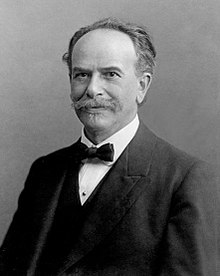
Franz Boas (1858–1942), one of the pioneers of modernistic anthropology, ofttimes chosen the "Father of American Anthropology"
Franz Boas (1858–1942) established academic anthropology in the United States in opposition to Morgan's evolutionary perspective. His approach was empirical, skeptical of overgeneralizations, and eschewed attempts to constitute universal laws. For case, Boas studied immigrant children to demonstrate that biological race was not immutable, and that human being deport and behavior resulted from nurture, rather than nature.
Influenced by the German tradition, Boas argued that the world was full of distinct cultures, rather than societies whose development could exist measured past how much or how little "civilization" they had. He believed that each culture has to be studied in its particularity, and argued that cross-cultural generalizations, like those made in the natural sciences, were not possible.
In doing and then, he fought discrimination against immigrants, blacks, and indigenous peoples of the Americas.[fourteen] Many American anthropologists adopted his calendar for social reform, and theories of race keep to be pop subjects for anthropologists today. The and so-chosen "Four Field Arroyo" has its origins in Boasian Anthropology, dividing the subject area in the four crucial and interrelated fields of sociocultural, biological, linguistic, and primitive anthropology (due east.g. archaeology). Anthropology in the United States continues to be deeply influenced by the Boasian tradition, specially its emphasis on civilisation.
Kroeber, Mead, and Benedict [edit]
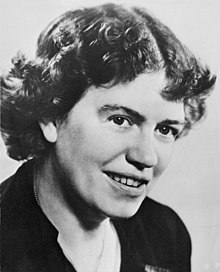
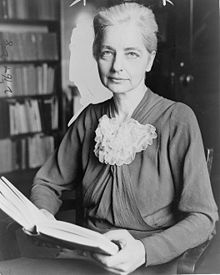
Boas used his positions at Columbia University and the American Museum of Natural History (AMNH) to train and develop multiple generations of students. His starting time generation of students included Alfred Kroeber, Robert Lowie, Edward Sapir, and Ruth Benedict, who each produced richly detailed studies of indigenous Northward American cultures. They provided a wealth of details used to assault the theory of a single evolutionary process. Kroeber and Sapir'southward focus on Native American languages helped establish linguistics equally a truly general science and complimentary information technology from its historical focus on Indo-European languages.
The publication of Alfred Kroeber'due south textbook Anthropology (1923) marked a turning point in American anthropology. Afterward three decades of amassing material, Boasians felt a growing urge to generalize. This was nigh obvious in the 'Civilisation and Personality' studies carried out by younger Boasians such as Margaret Mead and Ruth Benedict. Influenced by psychoanalytic psychologists including Sigmund Freud and Carl Jung, these authors sought to understand the style that private personalities were shaped by the wider cultural and social forces in which they grew up.
Though such works as Mead'south Coming of Historic period in Samoa (1928) and Benedict's The Chrysanthemum and the Sword (1946) remain popular with the American public, Mead and Benedict never had the impact on the discipline of anthropology that some expected. Boas had planned for Ruth Bridegroom to succeed him as chair of Columbia'south anthropology section, but she was sidelined in favor of Ralph Linton,[15] and Mead was limited to her offices at the AMNH.[16]
Wolf, Sahlins, Mintz, and political economy [edit]
In the 1950s and mid-1960s anthropology tended increasingly to model itself after the natural sciences. Some anthropologists, such as Lloyd Fallers and Clifford Geertz, focused on processes of modernization past which newly independent states could develop. Others, such equally Julian Steward and Leslie White, focused on how societies evolve and fit their ecological niche—an arroyo popularized by Marvin Harris.
Economic anthropology as influenced by Karl Polanyi and practiced by Marshall Sahlins and George Dalton challenged standard neoclassical economics to have account of cultural and social factors, and employed Marxian analysis into anthropological written report. In England, British Social Anthropology's paradigm began to fragment as Max Gluckman and Peter Worsley experimented with Marxism and authors such as Rodney Needham and Edmund Leach incorporated Lévi-Strauss's structuralism into their piece of work. Structuralism too influenced a number of developments in the 1960s and 1970s, including cognitive anthropology and componential analysis.
In keeping with the times, much of anthropology became politicized through the Algerian War of Independence and opposition to the Vietnam State of war;[17] Marxism became an increasingly pop theoretical approach in the discipline.[xviii] Past the 1970s the authors of volumes such as Reinventing Anthropology worried about anthropology'southward relevance.
Since the 1980s issues of power, such as those examined in Eric Wolf's Europe and the People Without History, take been central to the discipline. In the 1980s books like Anthropology and the Colonial See pondered anthropology's ties to colonial inequality, while the immense popularity of theorists such equally Antonio Gramsci and Michel Foucault moved issues of ability and hegemony into the spotlight. Gender and sexuality became popular topics, as did the relationship betwixt history and anthropology, influenced past Marshall Sahlins, who drew on Lévi-Strauss and Fernand Braudel to examine the relationship between symbolic meaning, sociocultural construction, and individual agency in the processes of historical transformation. Jean and John Comaroff produced a whole generation of anthropologists at the University of Chicago that focused on these themes. Likewise influential in these problems were Nietzsche, Heidegger, the critical theory of the Frankfurt School, Derrida and Lacan.[19]
Geertz, Schneider, and interpretive anthropology [edit]
Many anthropologists reacted against the renewed accent on materialism and scientific modelling derived from Marx past emphasizing the importance of the concept of culture. Authors such as David Schneider, Clifford Geertz, and Marshall Sahlins developed a more fleshed-out concept of culture every bit a web of significant or signification, which proved very pop inside and across the subject field. Geertz was to state:
"Assertive, with Max Weber, that homo is an fauna suspended in webs of significance he himself has spun, I take civilisation to exist those webs, and the analysis of information technology to be therefore not an experimental science in search of police force simply an interpretive ane in search of meaning."
—Clifford Geertz (1973)[20]
Geertz's interpretive method involved what he called "thick clarification". The cultural symbols of rituals, political and economical action, and of kinship, are "read" by the anthropologist equally if they are a document in a foreign language. The interpretation of those symbols must be re-framed for their anthropological audience, i.east. transformed from the "experience-near" only foreign concepts of the other culture, into the "experience-distant" theoretical concepts of the anthropologist. These interpretations must and then be reflected dorsum to its originators, and its adequacy every bit a translation fine-tuned in a repeated manner, a process called the hermeneutic circle. Geertz applied his method in a number of areas, creating programs of written report that were very productive. His assay of "religion as a cultural system" was specially influential outside of anthropology. David Schnieder's cultural analysis of American kinship has proven every bit influential.[21] Schneider demonstrated that the American folk-cultural emphasis on "claret connections" had an undue influence on anthropological kinship theories, and that kinship is not a biological feature but a cultural relationship established on very different terms in unlike societies.[22]
Prominent British symbolic anthropologists include Victor Turner and Mary Douglas.
The post-modern turn [edit]
In the late 1980s and 1990s authors such as James Clifford pondered ethnographic authorisation, in particular how and why anthropological knowledge was possible and authoritative. They were reflecting trends in research and discourse initiated by feminists in the academy, although they excused themselves from commenting specifically on those pioneering critics.[23] Nevertheless, key aspects of feminist theory and methods became de rigueur as part of the 'post-modern moment' in anthropology: Ethnographies became more than interpretative and reflexive,[24] explicitly addressing the author's methodology; cultural, gendered, and racial positioning; and their influence on his or her ethnographic analysis. This was part of a more general tendency of postmodernism that was popular contemporaneously.[25] Currently anthropologists pay attention to a wide diversity of issues pertaining to the contemporary globe, including globalization, medicine and biotechnology, indigenous rights, virtual communities, and the anthropology of industrialized societies.
Socio-cultural anthropology subfields [edit]
- Anthropology of art
- Cognitive anthropology
- Anthropology of development
- Ecological anthropology
- Economic anthropology
- Feminist anthropology and anthropology of gender and sexuality
- Ethnohistory and historical anthropology
- Kinship and family
- Legal anthropology
- Multimodal anthropology
- Media anthropology
- Medical anthropology
- Political anthropology
- Political economy in anthropology
- Psychological anthropology
- Public anthropology
- Anthropology of religion
- Cyborg anthropology
- Transpersonal anthropology
- Urban anthropology
- Visual anthropology
Methods [edit]
Mod cultural anthropology has its origins in, and adult in reaction to, 19th century ethnology, which involves the organized comparison of human societies. Scholars like E.B. Tylor and J.G. Frazer in England worked mostly with materials collected past others—commonly missionaries, traders, explorers, or colonial officials—earning them the moniker of "arm-chair anthropologists".
Participant ascertainment [edit]
Participant observation is one of the principal research methods of cultural anthropology. Information technology relies on the assumption that the best way to understand a group of people is to interact with them closely over a long period of fourth dimension.[26] The method originated in the field research of social anthropologists, especially Bronislaw Malinowski in Uk, the students of Franz Boas in the The states, and in the later urban research of the Chicago School of Sociology. Historically, the grouping of people being studied was a pocket-size, non-Western society. Still, today it may be a specific corporation, a church group, a sports team, or a small-scale town.[26] There are no restrictions every bit to what the subject of participant observation tin be, as long as the group of people is studied intimately by the observing anthropologist over a long menstruation of time. This allows the anthropologist to develop trusting relationships with the subjects of study and receive an inside perspective on the civilisation, which helps him or her to give a richer description when writing about the culture later. Observable details (similar daily time allotment) and more than hidden details (similar taboo behavior) are more hands observed and interpreted over a longer catamenia of time, and researchers tin find discrepancies betwixt what participants say—and oftentimes believe—should happen (the formal system) and what actually does happen, or between unlike aspects of the formal organisation; in contrast, a ane-time survey of people'southward answers to a set of questions might be quite consistent, but is less likely to show conflicts between different aspects of the social organization or between conscious representations and beliefs.[27]
Interactions betwixt an ethnographer and a cultural informant must go both ways.[28] Just equally an ethnographer may be naive or curious about a civilisation, the members of that civilization may be curious about the ethnographer. To establish connections that will eventually pb to a better agreement of the cultural context of a state of affairs, an anthropologist must be open to becoming part of the group, and willing to develop meaningful relationships with its members.[26] 1 way to practice this is to find a small expanse of common experience between an anthropologist and his or her subjects, so to expand from this common basis into the larger area of difference.[29] In one case a single connectedness has been established, it becomes easier to integrate into the community, and more probable that authentic and complete information is being shared with the anthropologist.
Earlier participant observation tin brainstorm, an anthropologist must choose both a location and a focus of report.[26] This focus may alter one time the anthropologist is actively observing the chosen group of people, but having an idea of what one wants to written report before beginning fieldwork allows an anthropologist to spend time researching background information on their topic. It can also be helpful to know what previous enquiry has been conducted in one'southward called location or on like topics, and if the participant observation takes place in a location where the spoken language is not i the anthropologist is familiar with, he or she will usually also learn that language. This allows the anthropologist to become better established in the community. The lack of demand for a translator makes communication more direct, and allows the anthropologist to give a richer, more than contextualized representation of what they witness. In improver, participant observation often requires permits from governments and research institutions in the area of report, and always needs some form of funding.[26]
The bulk of participant observation is based on conversation. This can take the grade of casual, friendly dialogue, or tin can also be a serial of more structured interviews. A combination of the two is often used, sometimes along with photography, mapping, artifact collection, and diverse other methods.[26] In some cases, ethnographers too turn to structured ascertainment, in which an anthropologist's observations are directed by a specific set of questions he or she is trying to answer.[thirty] In the case of structured ascertainment, an observer might be required to tape the lodge of a series of events, or depict a sure part of the surrounding environment.[xxx] While the anthropologist withal makes an effort to get integrated into the group they are studying, and still participates in the events equally they observe, structured observation is more than directed and specific than participant observation in general. This helps to standardize the method of study when ethnographic data is existence compared beyond several groups or is needed to fulfill a specific purpose, such every bit research for a governmental policy decision.
Ane mutual criticism of participant observation is its lack of objectivity.[26] Because each anthropologist has his or her own groundwork and set of experiences, each individual is probable to interpret the same civilisation in a different fashion. Who the ethnographer is has a lot to do with what he or she will eventually write most a culture, because each researcher is influenced by his or her own perspective.[31] This is considered a trouble especially when anthropologists write in the ethnographic present, a nowadays tense which makes a culture seem stuck in time, and ignores the fact that it may have interacted with other cultures or gradually evolved since the anthropologist made observations.[26] To avoid this, past ethnographers have advocated for strict training, or for anthropologists working in teams. However, these approaches have not generally been successful, and modern ethnographers often choose to include their personal experiences and possible biases in their writing instead.[26]
Participant observation has also raised ethical questions, since an anthropologist is in control of what he or she reports nigh a civilisation. In terms of representation, an anthropologist has greater ability than his or her subjects of study, and this has drawn criticism of participant ascertainment in general.[26] Additionally, anthropologists take struggled with the effect their presence has on a civilization. Merely by being present, a researcher causes changes in a culture, and anthropologists continue to question whether or not it is advisable to influence the cultures they written report, or possible to avoid having influence.[26]
Ethnography [edit]
In the 20th century, most cultural and social anthropologists turned to the crafting of ethnographies. An ethnography is a slice of writing about a people, at a particular place and fourth dimension. Typically, the anthropologist lives amidst people in another club for a menses of time, simultaneously participating in and observing the social and cultural life of the group.
Numerous other ethnographic techniques have resulted in ethnographic writing or details being preserved, as cultural anthropologists also curate materials, spend long hours in libraries, churches and schools poring over records, investigate graveyards, and decipher ancient scripts. A typical ethnography volition besides include data about physical geography, climate and habitat. It is meant to be a holistic piece of writing about the people in question, and today often includes the longest possible timeline of past events that the ethnographer can obtain through primary and secondary research.
Bronisław Malinowski developed the ethnographic method, and Franz Boas taught information technology in the United States. Boas' students such as Alfred L. Kroeber, Ruth Benedict and Margaret Mead drew on his formulation of culture and cultural relativism to develop cultural anthropology in the United States. Simultaneously, Malinowski and A.R. Radcliffe Dark-brown's students were developing social anthropology in the United Kingdom. Whereas cultural anthropology focused on symbols and values, social anthropology focused on social groups and institutions. Today socio-cultural anthropologists nourish to all these elements.
In the early on 20th century, socio-cultural anthropology adult in different forms in Europe and in the Us. European "social anthropologists" focused on observed social behaviors and on "social construction", that is, on relationships amongst social roles (for example, husband and wife, or parent and kid) and social institutions (for example, organized religion, economy, and politics).
American "cultural anthropologists" focused on the ways people expressed their view of themselves and their earth, peculiarly in symbolic forms, such every bit art and myths. These two approaches frequently converged and mostly complemented one another. For example, kinship and leadership function both as symbolic systems and as social institutions. Today almost all socio-cultural anthropologists refer to the work of both sets of predecessors, and accept an equal interest in what people do and in what people say.
Cross-cultural comparing [edit]
One ways by which anthropologists combat ethnocentrism is to appoint in the process of cross-cultural comparison. Information technology is important to test so-called "man universals" against the ethnographic record. Monogamy, for example, is frequently touted every bit a universal human being trait, nevertheless comparative written report shows that it is not. The Human Relations Surface area Files, Inc. (HRAF) is a research agency based at Yale University. Since 1949, its mission has been to encourage and facilitate worldwide comparative studies of man culture, lodge, and behavior in the past and nowadays. The name came from the Found of Human Relations, an interdisciplinary program/building at Yale at the time. The Plant of Human Relations had sponsored HRAF's precursor, the Cross-Cultural Survey (meet George Peter Murdock), equally role of an effort to develop an integrated science of human being beliefs and culture. The 2 eHRAF databases on the Web are expanded and updated annually. eHRAF World Cultures includes materials on cultures, past and present, and covers most 400 cultures. The second database, eHRAF Archaeology, covers major archaeological traditions and many more sub-traditions and sites around the world.
Comparison across cultures includies the industrialized (or de-industrialized) West. Cultures in the more traditional standard cross-cultural sample of pocket-sized scale societies are:
| Africa |
|
|---|---|
| Circum-Mediterranean |
|
| E Eurasia |
|
| Insular Pacific |
|
| Due north America |
|
| S America |
|
Multi-sited ethnography [edit]
Ethnography dominates socio-cultural anthropology. Nevertheless, many contemporary socio-cultural anthropologists take rejected earlier models of ethnography as treating local cultures equally bounded and isolated. These anthropologists continue to business organisation themselves with the singled-out ways people in different locales experience and understand their lives, but they ofttimes contend that one cannot understand these particular ways of life solely from a local perspective; they instead combine a focus on the local with an effort to grasp larger political, economic, and cultural frameworks that impact local lived realities. Notable proponents of this approach include Arjun Appadurai, James Clifford, George Marcus, Sidney Mintz, Michael Taussig, Eric Wolf and Ronald Daus.
A growing tendency in anthropological research and analysis is the use of multi-sited ethnography, discussed in George Marcus' article, "Ethnography In/Of the World System: the Emergence of Multi-Sited Ethnography". Looking at civilization as embedded in macro-constructions of a global social social club, multi-sited ethnography uses traditional methodology in various locations both spatially and temporally. Through this methodology, greater insight tin be gained when examining the impact of globe-systems on local and global communities.
Also emerging in multi-sited ethnography are greater interdisciplinary approaches to fieldwork, bringing in methods from cultural studies, media studies, science and applied science studies, and others. In multi-sited ethnography, research tracks a subject across spatial and temporal boundaries. For example, a multi-sited ethnography may follow a "thing", such as a particular commodity, as it is transported through the networks of global capitalism.
Multi-sited ethnography may as well follow ethnic groups in diaspora, stories or rumours that appear in multiple locations and in multiple time periods, metaphors that appear in multiple ethnographic locations, or the biographies of individual people or groups as they move through space and fourth dimension. It may also follow conflicts that transcend boundaries. An case of multi-sited ethnography is Nancy Scheper-Hughes' work on the international blackness marketplace for the merchandise of human being organs. In this research, she follows organs as they are transferred through various legal and illegal networks of capitalism, besides equally the rumours and urban legends that circulate in impoverished communities about child kidnapping and organ theft.
Sociocultural anthropologists have increasingly turned their investigative centre on to "Western" civilization. For example, Philippe Bourgois won the Margaret Mead Laurels in 1997 for In Search of Respect, a study of the entrepreneurs in a Harlem crack-den. Also growing more popular are ethnographies of professional communities, such as laboratory researchers, Wall Street investors, law firms, or information applied science (It) figurer employees.[32]
Topics in cultural anthropology [edit]
Kinship and family [edit]
Kinship refers to the anthropological report of the means in which humans grade and maintain relationships with 1 some other, and further, how those relationships operate within and ascertain social arrangement.[33]
Research in kinship studies ofttimes crosses over into dissimilar anthropological subfields including medical, feminist, and public anthropology. This is likely due to its primal concepts, as articulated by linguistic anthropologist Patrick McConvell:
Kinship is the bedrock of all human societies that nosotros know. All humans recognize fathers and mothers, sons and daughters, brothers and sisters, uncles and aunts, husbands and wives, grandparents, cousins, and often many more than complex types of relationships in the terminologies that they use. That is the matrix into which human children are built-in in the bully majority of cases, and their start words are often kinship terms.[34]
Throughout history, kinship studies accept primarily focused on the topics of marriage, descent, and procreation.[35] Anthropologists have written extensively on the variations inside spousal relationship across cultures and its legitimacy equally a homo institution. There are stark differences between communities in terms of marital practice and value, leaving much room for anthropological fieldwork. For example, the Nuer of Sudan and the Brahmans of Nepal practice polygyny, where one man has several marriages to ii or more women. The Nyar of Republic of india and Nyimba of Tibet and Nepal practice polyandry, where one adult female is frequently married to two or more men. The marital exercise constitute in most cultures, even so, is monogamy, where 1 woman is married to 1 human being. Anthropologists also study different marital taboos beyond cultures, most commonly the incest taboo of marriage within sibling and parent-child relationships. It has been constitute that all cultures have an incest taboo to some caste, but the taboo shifts between cultures when the marriage extends beyond the nuclear family.[33]
There are similar foundational differences where the human action of procreation is concerned. Although anthropologists accept found that biology is acknowledged in every cultural relationship to procreation, at that place are differences in the ways in which cultures appraise the constructs of parenthood. For example, in the Nuyoo municipality of Oaxaca, Mexico, it is believed that a child can have partible maternity and partible paternity. In this instance, a child would have multiple biological mothers in the case that it is born of one woman and and then breastfed by another. A kid would have multiple biological fathers in the case that the mother had sex activity with multiple men, following the commonplace belief in Nuyoo culture that pregnancy must be preceded by sex activity with multiple men in order have the necessary aggregating of semen.[36]
Late twentieth-century shifts in interest [edit]
In the 20-first century, Western ideas of kinship have evolved beyond the traditional assumptions of the nuclear family, raising anthropological questions of consanguinity, lineage, and normative marital expectation. The shift can be traced back to the 1960s, with the reassessment of kinship's bones principles offered by Edmund Leach, Rodney Neeham, David Schneider, and others.[35] Instead of relying on narrow ideas of Western normalcy, kinship studies increasingly catered to "more ethnographic voices, human agency, intersecting power structures, and historical contex".[37] The study of kinship evolved to accommodate for the fact that it cannot be separated from its institutional roots and must pay respect to the guild in which it lives, including that society's contradictions, hierarchies, and private experiences of those within it. This shift was progressed further by the emergence of second-wave feminism in the early on 1970s, which introduced ideas of marital oppression, sexual autonomy, and domestic subordination. Other themes that emerged during this fourth dimension included the frequent comparisons between Eastern and Western kinship systems and the increasing corporeality of attending paid to anthropologists' own societies, a swift plough from the focus that had traditionally been paid to largely "foreign", non-Western communities.[35]
Kinship studies began to gain mainstream recognition in the late 1990s with the surging popularity of feminist anthropology, particularly with its work related to biological anthropology and the intersectional critique of gender relations. At this fourth dimension, there was the arrival of "3rd World feminism", a move that argued kinship studies could not examine the gender relations of developing countries in isolation, and must pay respect to racial and economic nuance besides. This critique became relevant, for instance, in the anthropological study of Jamaica: race and class were seen as the master obstacles to Jamaican liberation from economical imperialism, and gender as an identity was largely ignored. Third Globe feminism aimed to combat this in the early 20-first century by promoting these categories as coexisting factors. In Jamaica, marriage as an institution is often substituted for a series of partners, equally poor women cannot rely on regular financial contributions in a climate of economic instability. In addition, there is a common practice of Jamaican women artificially lightening their skin tones in order to secure economic survival. These anthropological findings, according to Third World feminism, cannot see gender, racial, or form differences equally carve up entities, and instead must acknowledge that they collaborate together to produce unique individual experiences.[37]
Rising of reproductive anthropology [edit]
Kinship studies have also experienced a rise in the interest of reproductive anthropology with the advancement of assisted reproductive technologies (ARTs), including in vitro fertilization (IVF). These advancements take led to new dimensions of anthropological research, as they challenge the Western standard of biogenetically based kinship, relatedness, and parenthood. According to anthropologists Maria C. Inhorn and Daphna Birenbaum-Carmeli, "ARTs have pluralized notions of relatedness and led to a more dynamic notion of "kinning" namely, kinship as a process, as something under construction, rather than a natural given".[38] With this engineering, questions of kinship have emerged over the difference between biological and genetic relatedness, as gestational surrogates can provide a biological environment for the embryo while the genetic ties remain with a 3rd party.[39] If genetic, surrogate, and adoptive maternities are involved, anthropologists have best-selling that there can be the possibility for iii "biological" mothers to a single child.[38] With ARTs, there are also anthropological questions concerning the intersections between wealth and fertility: ARTs are generally only available to those in the highest income bracket, meaning the infertile poor are inherently devalued in the arrangement. There have as well been bug of reproductive tourism and bodily commodification, equally individuals seek economic security through hormonal stimulation and egg harvesting, which are potentially harmful procedures. With IVF, specifically, at that place take been many questions of embryotic value and the status of life, specially as information technology relates to the manufacturing of stem cells, testing, and research.[38]
Current issues in kinship studies, such as adoption, take revealed and challenged the Western cultural disposition towards the genetic, "blood" tie.[40] Western biases against single parent homes have also been explored through like anthropological research, uncovering that a household with a single parent experiences "greater levels of scrutiny and [is] routinely seen as the 'other' of the nuclear, patriarchal family unit".[41] The power dynamics in reproduction, when explored through a comparative analysis of "conventional" and "unconventional" families, take been used to dissect the Western assumptions of child bearing and child rearing in contemporary kinship studies.
Critiques of kinship studies [edit]
Kinship, as an anthropological field of inquiry, has been heavily criticized across the bailiwick. One critique is that, as its inception, the framework of kinship studies was far too structured and formulaic, relying on dense linguistic communication and stringent rules.[37] Some other critique, explored at length by American anthropologist David Schneider, argues that kinship has been limited by its inherent Western ethnocentrism. Schneider proposes that kinship is not a field that tin can be applied cantankerous-culturally, as the theory itself relies on European assumptions of normalcy. He states in the widely circulated 1984 book A critique of the study of kinship that "[K]inship has been defined past European social scientists, and European social scientists apply their own folk civilization as the source of many, if not all of their means of formulating and understanding the globe about them".[42] Still, this critique has been challenged by the argument that it is linguistics, not cultural divergence, that has allowed for a European bias, and that the bias can exist lifted by centering the methodology on fundamental human concepts. Polish anthropologist Anna Wierzbicka argues that "mother" and "father" are examples of such central human concepts, and tin can only be Westernized when conflated with English language concepts such as "parent" and "sibling".[43]
A more recent critique of kinship studies is its solipsistic focus on privileged, Western human relations and its promotion of normative ideals of human exceptionalism. In Critical Kinship Studies, social psychologists Elizabeth Pare and Damien Riggs contend for a move beyond this homo-centered framework, opting instead to explore kinship through a "posthumanist" vantage point where anthropologists focus on the intersecting relationships of human animals, non-homo animals, technologies and practices.[44]
Institutional anthropology [edit]
The role of anthropology in institutions has expanded significantly since the end of the 20th century.[45] Much of this evolution can be attributed to the rise in anthropologists working outside of academia and the increasing importance of globalization in both institutions and the field of anthropology.[45] Anthropologists can be employed by institutions such equally for-profit business, nonprofit organizations, and governments.[45] For instance, cultural anthropologists are commonly employed past the United States federal regime.[45]
The ii types of institutions divers in the field of anthropology are total institutions and social institutions.[46] Full institutions are places that comprehensively coordinate the actions of people inside them, and examples of total institutions include prisons, convents, and hospitals.[46] Social institutions, on the other manus, are constructs that regulate individuals' day-to-twenty-four hours lives, such every bit kinship, religion, and economics.[46] Anthropology of institutions may analyze labor unions, businesses ranging from small enterprises to corporations, government, medical organizations,[45] education,[vi] prisons,[2] [4] and financial institutions.[thirteen] Nongovernmental organizations have garnered particular interest in the field of institutional anthropology because they are capable of fulfilling roles previously ignored past governments,[47] or previously realized past families or local groups, in an attempt to mitigate social bug.[45]
The types and methods of scholarship performed in the anthropology of institutions can take a number of forms. Institutional anthropologists may study the relationship between organizations or between an organization and other parts of society.[45] Institutional anthropology may also focus on the inner workings of an institution, such as the relationships, hierarchies and cultures formed,[45] and the ways that these elements are transmitted and maintained, transformed, or abandoned over time.[48] Additionally, some anthropology of institutions examines the specific design of institutions and their corresponding strength.[ix] More specifically, anthropologists may analyze specific events inside an institution, perform semiotic investigations, or analyze the mechanisms by which knowledge and civilisation are organized and dispersed.[45]
In all manifestations of institutional anthropology, participant observation is disquisitional to understanding the intricacies of the way an institution works and the consequences of deportment taken by individuals inside it.[49] Simultaneously, anthropology of institutions extends beyond exam of the commonplace involvement of individuals in institutions to discover how and why the organizational principles evolved in the way that they did.[48]
Mutual considerations taken by anthropologists in studying institutions include the physical location at which a researcher places themselves, as of import interactions frequently take place in private, and the fact that the members of an institution are often beingness examined in their workplace and may not take much idle time to discuss the details of their everyday endeavors.[l] The ability of individuals to present the workings of an establishment in a particular light or frame must additionally be taken into account when using interviews and document analysis to understand an institution,[49] as the involvement of an anthropologist may be met with distrust when information being released to the public is not direct controlled by the institution and could potentially exist damaging.[50]
Run into also [edit]
- Age-expanse hypothesis
- Anthropology of religion
- Bibliography of anthropology
- Ceremonial pole
- Community studies
- Communitas
- Cross-cultural psychology
- Cultural psychology
- Cultural development
- Cultural relativism
- Culture change
- Culturology
- Digital anthropology
- Engaged theory
- Ethnobotany
- Ethnomusicology
- Ethnozoology
- Folkloristics
- Guilt–shame–fear spectrum of cultures
- Intangible cultural heritage
- Kluckhohn and Strodtbeck'southward values orientation theory
- Nomads
References [edit]
- ^ Fisher, William F. (1997). "1997". Annual Review of Anthropology. 26: 439–64. doi:10.1146/annurev.anthro.26.1.439. S2CID 56375779.
- ^ a b Cunha, Manuela (2014). "The Ethnography of Prisons and Penal Solitude" (PDF). Almanac Review of Anthropology. 43: 217–33. doi:10.1146/annurev-anthro-102313-030349. hdl:1822/32800.
- ^ "In his earlier work, like many anthropologists of this generation, Levi-Strauss draws attention to the necessary and urgent task of maintaining and extending the empirical foundations of anthropology in the exercise of fieldwork.": In Christopher Johnson, Claude Levi-Strauss: the formative years, Cambridge University Press, 2003, p. 31
- ^ a b Rhodes, Lorna A. (2001). "Toward an Anthropology of Prisons". Almanac Review of Anthropology. xxx: 65–83. doi:10.1146/annurev.anthro.30.ane.65. S2CID 53974202.
- ^ Tylor, Edward. 1920 [1871]. Primitive Culture. Vol one. New York: J.P. Putnam's Sons.
- ^ a b Magolda, Peter M. (March 2000). "The Campus Bout: Ritual and Community in Higher Education". Anthropology & Teaching Quarterly. 31: 24–46. doi:ten.1525/aeq.2000.31.1.24.
- ^ Milton, Kay (1996). Environmentalism and Cultural Theory: Exploring the part of anthropology in environmental soapbox. New York: Routledge Printing. pp. 8–37. ISBN0415115302.
- ^ Diamond, Jared. Guns, Germs and Steel.
- ^ a b Levitsky, Steven; Murillo, Maria (2009). "Variation in Institutional Strength". Annual Review of Political Science. 12: 115–33. doi:10.1146/annurev.polisci.11.091106.121756. S2CID 55981325.
- ^ "Archived copy". Archived from the original on 2007-06-thirteen. Retrieved 2007-06-13 .
{{cite spider web}}: CS1 maint: archived copy as title (link) - ^ Heyer, Virginia (1948). "In Answer to Elgin Williams". American Anthropologist. 50 (1): 163–66. doi:10.1525/aa.1948.fifty.1.02a00290.
- ^ "Anthropology for beginners: Social and cultural anthropology". Retrieved eighteen March 2014. Academic web log postal service explaining the similarities/differences betwixt social and cultural anthropology.
- ^ a b Ho, Karen (2009). "Liquidated: An Ethnography of Wall Street". Contemporary Sociology: A Journal of Reviews. 41: 739–47.
- ^ Stocking, George W. (1968) Race, Civilization, and Development: Essays in the history of anthropology. London: The Free Press.
- ^ Mead, Margaret (2005). Ruth Benedict: A Humanist in Anthropology . Columbia University Press. p. 55. ISBN978-0-231-13491-0.
Ruth Benedict Ralph Linton,.
- ^ Lutkehaus, Nancy (2008). Margaret Mead: The Making of an American Icon . Princeton University Printing. ISBN978-0-691-00941-4.
margaret Mead.
- ^ Fanon, Frantz. (1963) The Wretched of the World, transl. Constance Farrington. New York, Grove Weidenfeld.
- ^ Nugent, Stephen Some reflections on anthropological structural Marxism The Journal of the Royal Anthropological Plant, Volume 13, Number 2, June 2007, pp. 419–31
- ^ Lewis, Herbert Due south. (1998) The Misrepresentation of Anthropology and its Consequences American Anthropologist 100:" 716–31
- ^ Geertz, Clifford (1973). The Interpretation of Cultures . Bones Books. pp. 5.
- ^ Roseberry, William (1989). "Balinese Cockfights and the Seduction of Anthropology" in Anthropologies and Histories: essays in culture, history and political economy. New Brunswick, NJ: Rutgers University Press. pp. 17–28.
- ^ Carsten, Janet (2004). After Kinship . Cambridge: Cambridge University Press. pp. 18–20.
- ^ Clifford, James and George E. Marcus (1986) Writing culture: the poetics and politics of ethnography. Berkeley: University of California Printing.
- ^ Dolores Janiewski, Lois W. Banner (2005) Reading Benedict / Reading Mead: Feminism, Race, and Imperial Visions, p.200 quotation:
Within anthropology's "ii cultures"—the positivist/objectivist manner of comparative anthropology versus a reflexive/interpretative anthropology—Mead has been characterized as a "humanist" heir to Franz Boas's historical particularism—hence, associated with the practices of interpretation and reflexivity [...]
- ^ Gellner, Ernest (1992) Postmodernism, Reason, and Religion. London/New York: Routledge. pp. 26–50
- ^ a b c d e f g h i j thou Monaghan, John; But, Peter (2000). Social and Cultural Anthropology: A Very Short Introduction. New York: Oxford University Printing. ISBN978-0-19-285346-2.
- ^ DeWalt, Chiliad. M., DeWalt, B. R., & Wayland, C. B. (1998). "Participant ascertainment." In H. R. Bernard (Ed.), Handbook of methods in cultural anthropology. pp. 259–99. Walnut Creek, CA: AltaMira Press.
- ^ Tierney, Gerry (2007). "Becoming a Participant Observer". In Angrosino, Michael (ed.). Doing Cultural Anthropology: Projects for Ethnographic Data Drove. Prospect Heights, IL: Waveland Printing.
- ^ Swick Perry, Helen (1988). "Using Participant Ascertainment to Construct a Life History". In Berg, David (ed.). The Self in Social Inquiry. Kenwyn Smith. Newbury Park, CA: Sage Publications.
- ^ a b Cost, Laurie J. (2007). "Carrying Out a Structured Observation". In Angrosino, Michael (ed.). Doing Cultural Anthropology: Projects for Ethnographic Data Drove. Prospect Heights, IL: Waveland Press.
- ^ Rosaldo, Renato (1989). Culture and Truth. Boston, MA: Buoy Press.
- ^ Dissertation Abstract
- ^ a b Guest, Kenneth J. (2013). Cultural Anthropology: A Toolkit for a Global Age. New York: Westward.W. Norton & Visitor. pp. 349–91.
- ^ McConvell, Patrick (2013). "Introduction: kinship change in anthropology and linguistics". Kinship Systems: Change and Reconstruction. Salt Lake Metropolis: University of Utah Printing: i–eighteen.
- ^ a b c Peletz, Michael G. (1995). "Kinship Studies in Late Twentieth-Century Anthropology". Annual Review of Anthropology. 24: 345–56. doi:10.1146/annurev.anthro.24.1.343.
- ^ Simply, Peter; Monaghan, John (2000). Social and Cultural Anthropology: A Very Brusk Introduction . Oxford: Oxford University Press. pp. 81–88.
- ^ a b c Rock, Linda (2001). New Directions in Anthropological Kinship. Lanham, MD: Rowman & Littlefield Publishers. pp. 1–368.
- ^ a b c Birenbaum-Carmeli, Daphna; Inhorn, Maria C. (2008). "Assisted Reproductive Technologies and Culture Change". Almanac Review of Anthropology. 37: 182–85. doi:ten.1146/annurev.anthro.37.081407.085230. S2CID 46994808.
- ^ Franklin, Sarah; Ragoné, Helena (1998). Reproducing Reproduction: Kinship, Ability, and Technological Innovation. Philadelphia: University of Pennsylvania Printing. p. 129.
- ^ Logan, Janette (2013). "Contemporary Adoptive Kinship". Child & Family unit Social Work. xviii (1): 35–45. doi:ten.1111/cfs.12042.
- ^ Ginsburg, Faye G.; Rapp, Rayna (1995). Conceiving the New World Club: The Global Politics of Reproduction. Berkeley and Los Angeles: University of California Press.
- ^ Schneider, David M. (1984). A critique of the written report of kinship. Ann Arbor: Academy of Michigan Press.
- ^ Wierzbicka, Anna (2016). "Back to 'Mother' and 'Father': Overcoming the Eurocentrism of Kinship Studies through Viii Lexical Universals" (PDF). Current Anthropology. 57 (iv): 408–28. doi:x.1086/687360. hdl:1885/152274. S2CID 148193954.
- ^ Skin, Elizabeth; Riggs, Damien W. (2016). Critical Kinship Studies. Basingstoke, UK: Palgrave Macmillan. pp. 10–20.
- ^ a b c d e f yard h i Douglas, Caulkins (2012). A Companion to Organizational Anthropology. Hoboken, NJ: Wiley.
- ^ a b c Hejtmanek, Katie Rose (28 November 2016). "Institutions". Oxford Bibliographies.
- ^ Fisher, William F. (1997). "1997". Almanac Review of Anthropology. 26: 439–64. doi:10.1146/annurev.anthro.26.ane.439. S2CID 56375779.
- ^ a b Smith, Dorothy E. (2006). Institutional Ethnography every bit Practice. Lanham, MD: Rowman & Littlefield Publishers, Inc.
- ^ a b Verlot, Marc (2001). "Are politics human? Problems and challenges of institutional anthropology". Social Anthropology. 9 (3): 345–53. doi:10.1111/j.1469-8676.2001.tb00162.x.
- ^ a b Riles, Annelise (2000). The Network Inside Out. The Academy of Michigan Printing.
External links [edit]
Source: https://en.wikipedia.org/wiki/Cultural_anthropology
0 Response to "Anthropologists Tend to Ignore Religion and Art in Understanding Other Cultures"
Post a Comment