Allens Flowers Gifts Antiques and Fine Art Inc
What to look for on the back of a painting — an expert guide
From its auction and exhibition history and provenance to notes from the artist on which way is 'UP', the details found on the 'verso' can significantly raise a painting'due south value
1. Who, what, when... and where
First and foremost, you'll want to know who painted your picture. Artists started signing their works around the 15th century, and while their signatures are about normally on the front, in more than recent times they have been applied to the contrary.
Christie's specialists can check signatures past looking them up in the artist's catalogue raisonné and, sometimes, even narrow downward the date a work was painted based on the evolution of a signature over time.
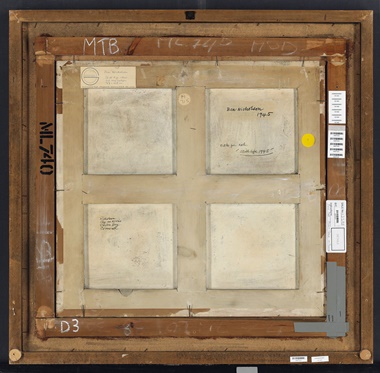
Nicholson's accost in Cornwall has been added bottom left of the dorsum of the picture
The artist will usually also have provided a championship or date. And sometimes more than besides.
'Also as signing, naming and dating his works on the reverse, the British artist Ben Nicholson (1894-1982) often included his address,' says Christie'due south Modern British and Irish Fine art specialist Alice Murray. 'It'southward a lovely add-on that helps you build the story behind the artwork.'
ii. Materials can narrow downward a painting's origins
Artists began switching from working on wooden panels to canvas in the 15th and 16th centuries because information technology enabled larger paintings. Painting on copper sheets also became stylish in the 17th century.
Stamps and labels from the suppliers of these materials tin contain the names and addresses of their businesses. Reference lists — such as Alexander Katlan'due south American Artists' Materials Suppliers Directory — can be used to track them down, and in turn, narrow down when and where a work was made.
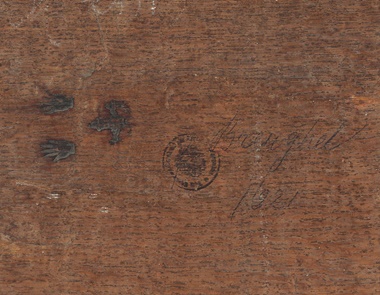
The contrary of a 16th-century oil painting console showing the brand of the metropolis of Antwerp — a pair of hands higher up a castle. The mark dates from 1617, when new regulations drawn up past the Antwerp Joiners' Guild stated 'every joiner is from now on obliged to punch his marker on frames and panels made past him, on pain of a fine of three guilders'
Comparing the date the materials were purchased with the date the artist signed the finished work tin even requite you an idea of how long information technology took to complete.
The types of materials used to create a piece of work's board, cradle or stretcher, along with how it was synthetic, besides vary over time and between places.
Soft wood, such as poplar, was used in Italy, while difficult woods, for example oak, was used in United kingdom of great britain and northern ireland and holland. Another clue can be obtained from how the canvas is fixed to the stretcher — staples replaced nails after the 1940s.
3. Labels indicate provenance and exhibition history
When a gallery or museum displays a work of art it often attaches a label to its dorsum that indicates the artist'due south name, the picture'south title, and usually a date, inventory number and address.
'With the advent of the internet information technology has become much easier to enquiry these labels,' explains Impressionist and Modern Art specialist Veronica Scarpati. 'For example, the Museum of Modern Art has digitised all of its exhibition catalogues, printing releases and lender lists as far back equally 1929.'
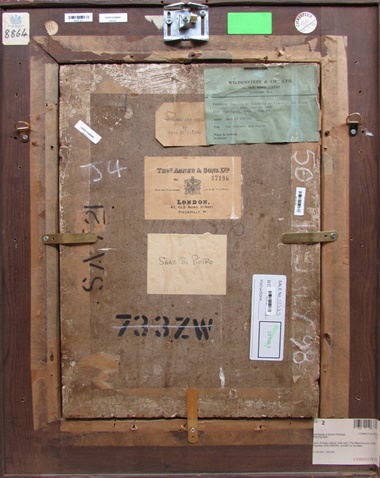
The dorsum of Pietro'southward painting with stencils, stickers and labels, including those of London dealer Thomas Agnew & Sons and New York gallery Wildenstein & Co.
Other key players to look out for include institutions such equally the Regal Academy or the Metropolitan Museum of Art, and dealers similar Richard Green, The Fine Art Club or Wildenstein & Co., as seen, top right, on the back of the pic shown to a higher place.
Other labels that record a painting'south journeying can come up from conservators, customs and border controls, or even defunct bureaucratic mechanisms such as the Nazis' Bedchamber of Civilization, which stamped its double-headed eagle logo on to the back of the fine art it looted.
4. Inscriptions will also have a story to tell
Individual collectors throughout history have added their own names to the back of a work. King Charles I of England (1600-1649), for example, branded his initials 'CR' topped with a crown onto the opposite of works in his royal collection.
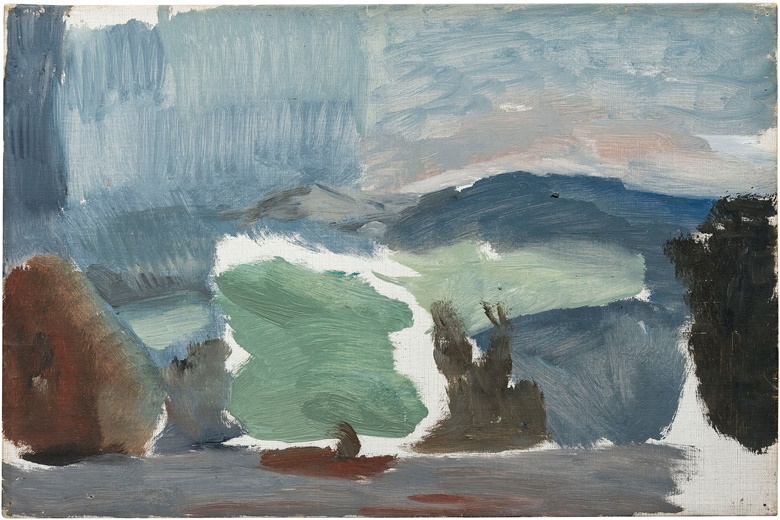
Ivon Hitchens (1893-1979), Hills and Darkening Heaven: Rain over the Downs. Oil on canvass. 12½ ten eighteen½ in (31.7 x 47 cm). Sold for £32,500 on 23 January 2022 at Christie's in London. Artwork: © The Manor of Ivon Hitchens. All rights reserved, DACS 2020
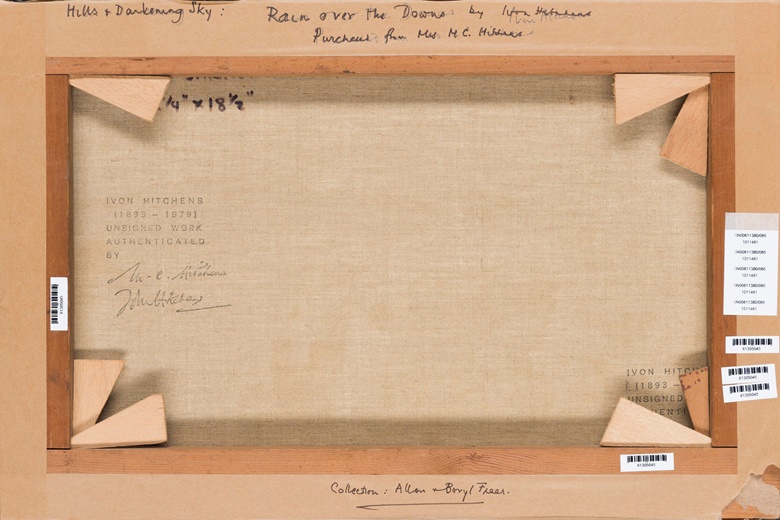
Allen Freer's handwritten provenance is on the bottom of the stretcher for Hills and Darkening Sky
'On the back of this landscape [above] past Ivon Hitchens (1893-1979) you lot have the stamp of his wife, Mollie, as well every bit a later, handwritten note placing it in the collection of Allen and Beryl Freer,' explains Alice Murray.
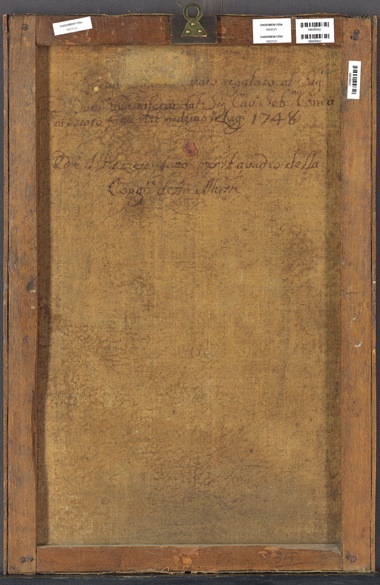
The back of Conca's painting features a handwritten inscription indicating that is was gift to one D. Domenico Guastaferro
In 2019, Christie's sold a painting [above] by Sebastiano Conca (1680-1764), which contains an old mitt-written note that describes its title, appointment and the fact it was a bozzetto — or sketch — for painting, equally well as providing some provenance — that it was gifted to one D. Domenico Guastaferro in July 1748.
If you determine to add a support to the back of your painting, it might be an thought to utilise Perspex so that the labels remain visible, or ask a paper conservator to carefully transfer them onto the new board.
5. Inventory numbers reveal a work's auction history
Since the early on 19th century Christie'due south has marked the dorsum of pictures with an inventory number. Initially these numbers were stencilled in black ink, while other sale houses used chalk. (Today, rather than stencilling numbers on the back of pictures, information technology is more mutual for a sticker with a barcode to be practical.)
'These numbers correspond to records that tell us when and where something was sold, and sometimes who sold it and what cost was paid,' explains Christie'southward librarian and archivist Lynda Macleod. 'The Christie's athenaeum in London has details of most of the sales held during the auction house's 254 years in business.'
'When cataloguing paintings these stencils allow us not only to piece together provenance, simply also to come across if the work has been attributed to different artists in the past,' adds Olivia Ghosh, a specialist in Christie's Old Masters department.
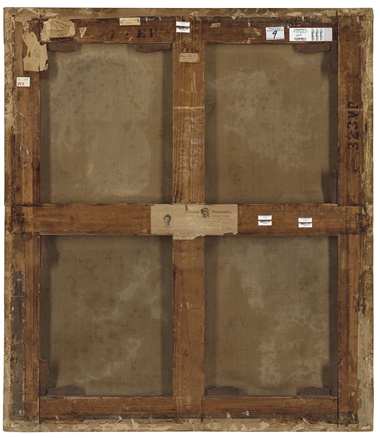
The contrary of Rembrandt's Man with a Sword showing its auction stencils, and in the centre, an 1898 Amsterdam exhibition label
In 2013, Christie's sold a portrait by Rembrandt (1606-1669)and his studio which had '272ER' stencilled on the back. 'That pointed us to a 1928 auction at Christie's of a collection belonging to Sir George Lindsay Holford,' Ghosh explains.
'From there we traced the painting's provenance back to his male parent, Robert Stayner Holford, who was the founder of the Burlington Fine Arts Club and owned three other Rembrandts, all now in museums. Knowing these details tin add bang-up value to a painting.'
6. If the painting has been lined, repair work may accept been carried out
If the rear of the sail has traces of glue effectually the edges, or feels thick and new, the painting may have been lined. This refers to the process of attaching an additional layer of sheet to the original surface in order to repair holes and tears and stabilise the painting.
'Lining a sheet was, and nonetheless is, a common practice for Former Master paintings,' says Ghosh. 'In the past it was oftentimes done with a heavy hand, but now it can be completed without damaging the pigment's surface.'
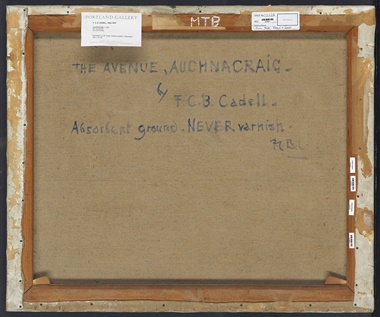
F.C.B. Cadell left clear instructions on the back of his works nigh how to care for them in the futurity
'The Scottish colourist F.C.B. Cadell (1883-1937) left clear instructions regarding how to maintain the condition of his works on their opposite,' says Alice Murray. 'On the dorsum of The Avenue, Auchnacraig [above] are the words "Absorbent ground/NEVER varnish", because Cadell felt the chalky quality of his paint surface was of utmost importance.'
vii. Warped stretchers can be a giveaway that it has been hung in humid conditions
Major cracks in the work might indicate that information technology has been hung in a hot, dry identify, such as to a higher place a fireplace, while warped stretchers could suggest it lived in a bathroom. 'Neither are appropriate,' states Ghosh.
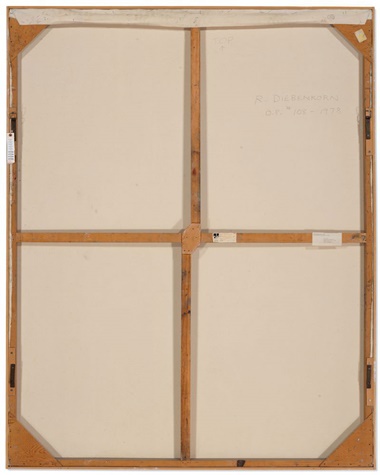
The reverse of Diebenkorn's painting helpfully explains which fashion upwardly it should be hung
While not venturing then far as to specify where they should exist hung, some artists, such as Richard Diebenkorn (1922-1993), helpfully leave notes to betoken their correct orientation. On the dorsum of the piece of work to a higher place Diebenkorn has written in pencil 'TOP', with an pointer pointing upwards.
Sign upwards today
The Online Mag delivers the all-time features, videos, and auction
news to your inbox every weekSubscribe
eight. On rare occasions, the dorsum of a painting can even reveal another work of art
Every now and once again the back of a painting can reveal something that rivals the importance of the work of art on the front, such as a handwritten notation past the artist —or even a 2d picture.
'Materials have historically been expensive, so impoverished artists were known to try out different compositions on the same supports,' Ghosh explains.
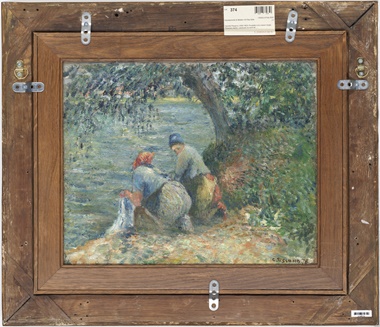
Gear up into the back of Pissarro'south 1878 scene of farmyard birds is another piece of work entirely, depicting two women washing laundry
Veronica Scarpati proffers an example. 'In Feb this year Christie's sold a piece of work by Camille Pissarro (1830-1903) which had a second, signed Pissarro on the reverse,' she explains.
'Christie's art handlers mounted it in a custom-made support so that both sides could be seen during the auction preview. If it had been hanging on a wall, no 1 would have had an inkling of what the back was hiding.'
Source: https://www.christies.com/features/8-things-you-can-learn-from-the-back-of-a-painting-10293-1.aspx
0 Response to "Allens Flowers Gifts Antiques and Fine Art Inc"
Post a Comment